A stuck glass office door can slow down your whole workday in minutes. If the key will not turn, the latch will not catch, or the door stays loose even when locked, office glass door lock repair becomes more than a maintenance job – it becomes a security and access problem.
Glass doors look clean and professional, but their lock systems can be less forgiving than standard wooden or metal doors. In many offices, these doors get used constantly by staff, visitors, cleaners, and delivery teams. That daily wear adds up. A lock that felt slightly stiff last week can stop working completely today.
Why office glass door lock repair needs quick attention
When an office glass door lock starts failing, the problem rarely stays small. A loose cylinder can become a full lockout. A misaligned latch can lead to a door that appears locked but is not actually secure. In a shared office, retail unit, clinic, or commercial building, that creates risk fast.
There is also the issue of business disruption. Staff may not be able to open on time. A manager may need to stand at the entrance letting people in one by one. Customers notice when the front door is giving trouble, and that is not the kind of first impression any business wants.
Quick repair also helps prevent unnecessary replacement. In many cases, the lock body, patch fitting, strike plate, or alignment can be corrected before the entire hardware set has to be changed.
Common office glass door lock problems
Glass door locks do not all fail in the same way. Some issues come from the lock itself, while others come from how the door sits in the frame.
The key turns but nothing happens
This usually points to a worn internal mechanism, a disconnected cam, or damaged lock components. It can also happen when the latch no longer lines up with the strike. To the user, it feels like the lock is working, but the door still will not secure properly.
The key will not turn smoothly
A stiff keyway often means dirt buildup, worn pins, poor key condition, or internal damage. It might still open with force for a while, but forcing it is risky. Broken keys inside glass door locks are common after weeks of “making it work.”
The door is hard to close or lock
This is often an alignment issue, not just a lock issue. Glass doors can shift slightly over time, especially in busy commercial spaces. Hinges, floor springs, and patch fittings all affect how the latch meets the strike point.
The lock feels loose on the glass door
A loose handle or lock fitting should not be ignored. Glass door hardware depends on proper mounting and stable pressure points. If the fitting moves too much, the lock may stop engaging correctly, and the glass door itself can become harder to operate safely.
The door locks from one side only
This can happen with double-sided keyed systems, thumb-turn setups, or partial internal failure. Sometimes the issue is wear. Sometimes it is the wrong lock type for the traffic level the door handles every day.
Repair or replace – what makes sense?
This depends on the condition of the lock, the age of the hardware, and how urgent the situation is.
If the lock has a minor alignment problem, loose fittings, or a serviceable internal mechanism, repair is usually the better option. It is faster, more affordable, and less disruptive. A good locksmith can often restore proper function on-site without changing the full setup.
Replacement makes more sense when the lock is badly worn, parts are broken beyond repair, the key system is compromised, or the current hardware is not giving enough security for the office. This is especially relevant after staff turnover, lost keys, attempted tampering, or repeated repair history.
For many businesses, the best answer is not just fixing what is broken. It is using the repair visit to decide whether the current lock still matches the way the office operates.
What a locksmith checks during office glass door lock repair
A proper repair is not just spraying lubricant into the keyhole and hoping for the best. The lock has to be checked as part of the full door system.
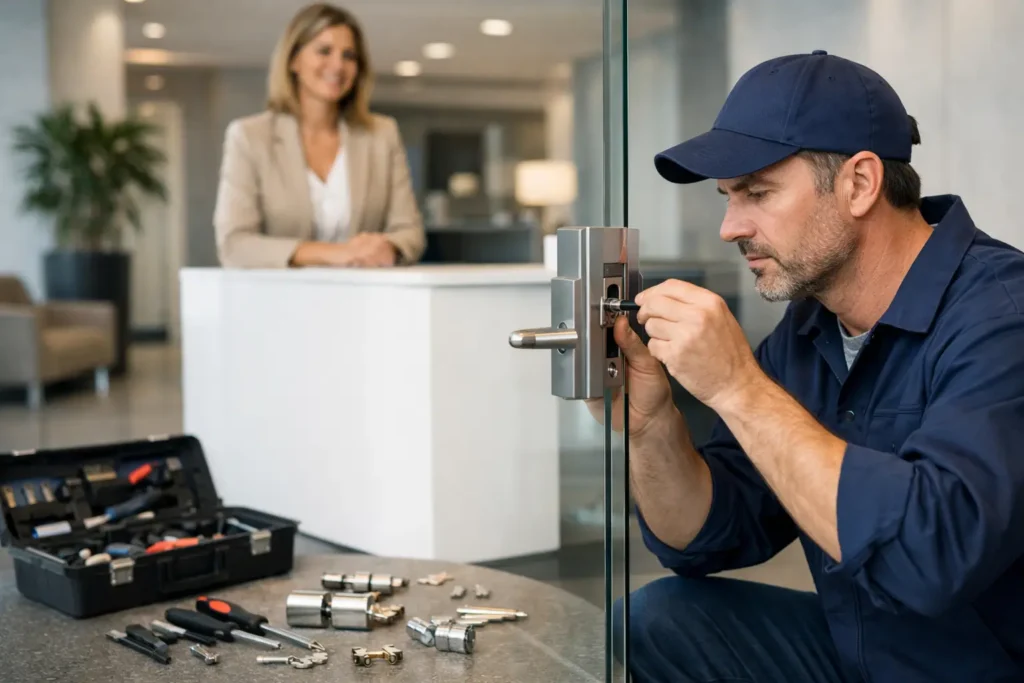
A locksmith will usually inspect the lock cylinder, latch action, handle set, strike alignment, mounting stability, and key condition. On glass doors, they may also check the patch fittings, frame contact points, and whether the door is dropping, dragging, or closing off-center.
That matters because the visible symptom is not always the real cause. A customer may think the key is the issue, but the actual problem could be a shifted door or stressed lock body. Fixing only the symptom means the problem comes back.
Signs your office should not delay service
Some lock problems can wait until after business hours. Others should be handled the same day.
If the door cannot lock securely, cannot open reliably, requires force, or traps people inside or outside, it needs prompt attention. The same goes for locks that have become loose on the glass panel, keys that feel close to snapping, or doors that appear locked but still pull open.
Commercial spaces also need to think beyond convenience. If sensitive rooms, inventory areas, or customer-facing entrances are involved, a weak lock becomes a liability issue as much as a hardware issue.
Why DIY glass door lock repair is risky
It is tempting to try a quick fix, especially if the problem seems minor. But glass doors are not the place for trial and error.
Unlike standard doors, glass door hardware often works within tight tolerances. Overtightening, forcing a stuck lock, removing the wrong fitting, or using mismatched parts can make the issue worse. In some cases, the door becomes harder to secure. In others, the hardware or glass panel may be put under stress.
There is also the business cost of a failed DIY attempt. If a temporary fix causes a full lock failure during operating hours, the disruption usually costs more than calling a locksmith early.
Choosing the right lock setup after repair
Not every office needs the same level of security, and that is where practical advice matters.
A small private office may only need a dependable keyed lock with smoother operation and better durability. A shared workspace may need better key control because too many copies are circulating. A unit with staff turnover may benefit from rekeying or replacement rather than repairing an old lock that has already become a management headache.
If the office uses glass doors at the main entrance, appearance also matters. The hardware should still look clean and professional after service. Good repair work should improve function without making the entrance look patched together.
Fast service matters in commercial lock problems
Office lock issues rarely happen at a convenient time. It is usually early in the morning, right before closing, during a tenant handover, or when someone is already in a rush.
That is why response time matters almost as much as the repair itself. A mobile locksmith who can come on-site, assess the door quickly, and carry out the right repair in one visit saves time, reduces stress, and helps the business get back to normal without dragging the issue into the next day.
For companies that manage commercial units, retail fronts, or office suites, it also helps to work with a locksmith who understands that speed alone is not enough. The fix has to hold up under daily use.
When experienced repair work pays off
Office glass door lock repair is one of those jobs where experience shows. Glass doors have different hardware styles, different access needs, and different failure points from standard doors. The repair has to be practical, neat, and reliable.
A service-focused locksmith like Pro-Smith and Lock approaches the problem with that in mind – not just getting the door open, but making sure the lock works properly, the door lines up correctly, and the office can use it with confidence again.
If your office glass door has started sticking, slipping, or refusing to lock the way it should, do not wait for a full lockout to force the issue. Getting it checked early is usually the simplest way to protect your schedule, your staff, and your front door security.