A mailbox key that suddenly spins, sticks, or disappears can leave more than bills trapped inside. It can also expose sensitive mail to theft. The best mailbox lock replacement options depend on who owns the mailbox, the lock style already installed, and whether the problem is a lost key, a damaged cylinder, or a worn-out door. Choosing the right replacement first saves time, avoids an incorrect purchase, and gets your mail secure again.
Start by confirming who owns the mailbox
Before buying a replacement lock, identify the type of mailbox you have. A privately owned mailbox at a single-family home, apartment building, or office may use a standard cam lock that a locksmith can replace on-site. These locks are common, affordable, and available in several lengths and key styles.
Community mailbox units are different. In many U.S. neighborhoods, the U.S. Postal Service owns and maintains the individual customer locks in centralized cluster mailbox units. If the mailbox is postal property, do not force the door open or install a lock yourself. Contact your local post office to confirm the process for replacing a lock and obtaining new keys.
For apartment or condominium mailboxes, the building manager, landlord, or homeowners association may control replacement rules. They may keep master keys, require a matching finish, or need to approve the work. A quick check prevents an unnecessary lock change or a conflict with property management.
Best mailbox lock replacement options by situation
Standard cam lock replacement
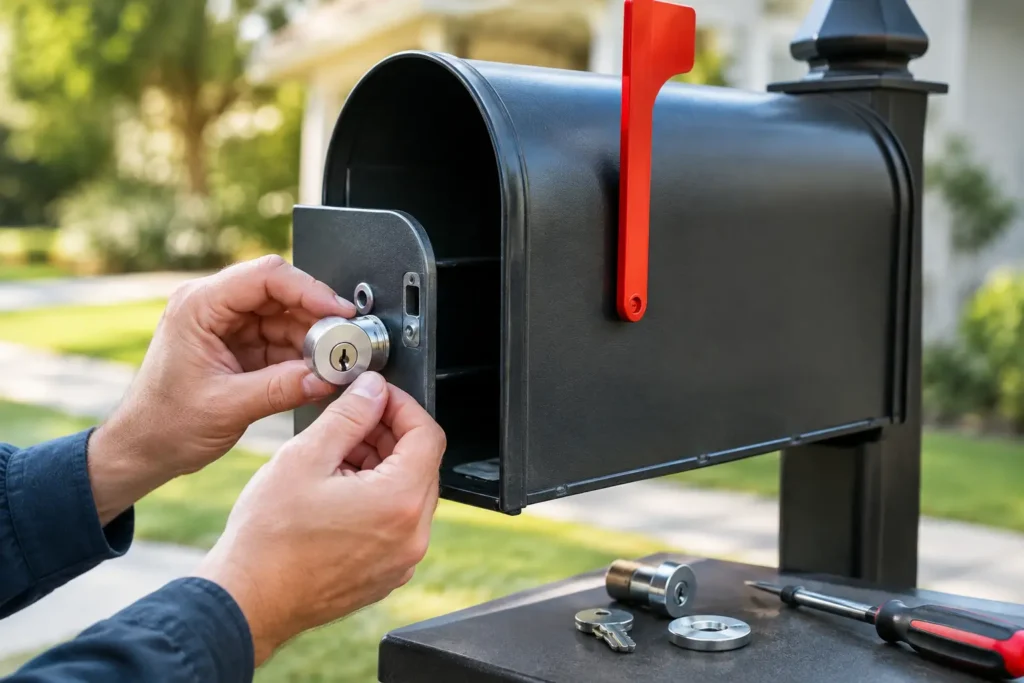
For most privately owned mailbox doors, a standard cam lock is the practical choice. It has a keyed cylinder at the front and a flat metal tailpiece, called a cam, at the back. When the key turns, the cam swings behind the mailbox frame to hold the door shut.
This option works well when the existing lock is loose, corroded, difficult to turn, or missing a key. It is also usually the fastest repair because a locksmith can match the lock body length and cam orientation to the mailbox already in place. Standard cam locks come in common sizes, but they are not one-size-fits-all. A lock that is too short may not reach properly, while one that is too long can sit loose and make the door harder to secure.
High-security mailbox cam lock
A high-security cam lock is worth considering if you have experienced mail theft, repeated tampering, or a lock that can be easily picked or pried. Compared with a basic replacement, better-quality models may use stronger internal pins, restricted keyways, hardened components, or designs that resist drilling and pulling.
The trade-off is cost. High-security options are more expensive, and replacement keys may need to be ordered through a locksmith rather than copied at a hardware store. For a mailbox containing bank statements, checks, business documents, or identity-sensitive mail, that extra control can be a sensible upgrade.
Tubular mailbox lock
Some mailboxes use a tubular lock rather than the familiar flat-key cam lock. A tubular key is round and has cuts around its edge. These locks are often found on certain commercial mailboxes, parcel lockers, cabinets, and older mailbox systems.
Tubular locks require a compatible replacement and key. Do not assume a standard cam lock will fit simply because the face diameter looks similar. The mounting hole, tailpiece, locking movement, and clearance behind the door must all match. A locksmith can identify the lock type quickly and install the correct unit without modifying the mailbox door unnecessarily.
Keyed-alike mailbox locks
A keyed-alike replacement lets one key operate more than one lock. This is particularly useful for homeowners who want the mailbox and a side gate, storage cabinet, or utility enclosure to use the same key. It can also help office managers reduce a crowded key ring when several privately owned mailboxes or cabinets need controlled access.
This option only works when the locks are compatible and can be keyed to the same system. It is a convenience upgrade, not automatically a security upgrade. If several people have old keys, changing to a new key combination is still the better choice after a move, staff change, or lost key incident.
What to check before replacing a mailbox lock
A mailbox lock can look simple from the outside, but a few small details determine whether the replacement will work. Measure the door thickness and the length of the lock body behind the faceplate. Check whether the mounting hole is round or shaped differently, and look at how far the cam must reach to engage the frame.
Cam direction matters just as much. Some locks turn clockwise to open; others turn counterclockwise. The cam may need to point up, down, left, or right when locked. Installing the right cylinder with the wrong cam can leave the door unsecured even though the key turns normally.
Also inspect the mailbox door itself. A replacement lock will not fully solve a bent door, broken hinge, cracked mounting hole, or badly damaged latch area. If the metal around the lock has been pulled outward, a locksmith may need to reinforce, realign, or repair the door before fitting the new lock. This is especially common after someone has tried to force open a jammed mailbox.
When a replacement key is enough
If the lock works smoothly and all keys are accounted for, cutting an additional key may be the lowest-cost solution. This is useful for households with multiple mail recipients or an office where an authorized staff member needs access.
A key-only solution is not appropriate when keys have been lost, stolen, or left with a former tenant, contractor, or employee. In those cases, replacing or rekeying the lock protects the mailbox from someone who may still have access. Since many small mailbox locks cannot be rekeyed economically, a complete lock replacement is often the cleaner option.
Why professional fitting can prevent repeat problems
Mailbox locks are inexpensive compared with door locks, which makes DIY replacement tempting. It can work when the lock is clearly identified and the mailbox is in good condition. But incorrect sizing, a poorly aligned cam, overtightened hardware, or a damaged door can turn a small repair into a mailbox that will not close or open reliably.
A professional locksmith can remove a failed lock without causing further damage, assess whether the mailbox is privately owned, and fit the correct replacement with the right cam and keying setup. This is particularly helpful if the key is broken in the cylinder, the door is already jammed, or you need access quickly without drilling through the mailbox.
For property managers and business owners, professional service also creates consistency. Multiple mailbox locks can be replaced, keyed alike where suitable, and checked for worn hardware in one visit. That reduces repeat callouts and helps prevent residents or staff from being left without access to important mail.
Protect the mailbox after the lock change
A new lock is a good time to improve everyday mailbox security. Collect mail regularly, especially when traveling, and avoid leaving checks, account documents, or deliveries inside for long periods. If the mailbox is in a poorly lit area, better lighting and a visible property camera can discourage tampering.
Keep the new keys in controlled hands. Avoid hiding a spare key near the mailbox, and do not label mailbox keys with your home address. If your mailbox has been targeted before, ask whether the door, latch, and mounting area need reinforcement rather than replacing only the cylinder.
The right mailbox lock is the one that fits correctly, matches the ownership rules, and gives you confidence that your mail is protected. If the door is damaged, the lock type is unclear, or you need secure access without delay, getting a qualified locksmith to assess it can be the quickest path back to a working mailbox.