A missing office key is not a small inconvenience when nobody can say who last had it, what door it opens, or whether it was copied. This guide to office key control helps office managers create a clear, workable process for protecting keys, controlling access, and acting quickly when a key goes missing.
Office key control does not need to be complicated. It needs to be consistent. The goal is simple: only the right people should have the right keys, for the right amount of time, with a record that makes sense when questions arise.
Why Office Key Control Matters
A typical office may have keys for the main entrance, glass doors, meeting rooms, storage cabinets, server rooms, mailboxes, gates, and individual suites. When keys are handed out casually, access can remain with former staff, contractors, tenants, or visitors long after it is needed.
The risk is not only burglary. Uncontrolled keys can expose confidential documents, equipment, stock, personal belongings, and restricted work areas. They can also create difficult conversations after an incident, especially when no one can confirm who had access.
Good key control gives management a practical answer to three questions: What keys exist? Who has each key? What should happen if one is lost, not returned, or no longer needed?
Start With a Complete Key Inventory
Before issuing new keys or changing locks, find out what is already in circulation. Walk through the office and list every lock that matters. Include external doors, internal restricted rooms, cabinets, padlocks, mailbox locks, and keys held by building management if they affect your space.
For each key, record a key number or code, the door or lock it operates, the number of copies authorized, and the person responsible for approving access. Do not label a key tag with a clear location such as Server Room or Finance Office. If a key ring is misplaced, that label gives away too much. Use a neutral code that can be matched to your internal record.
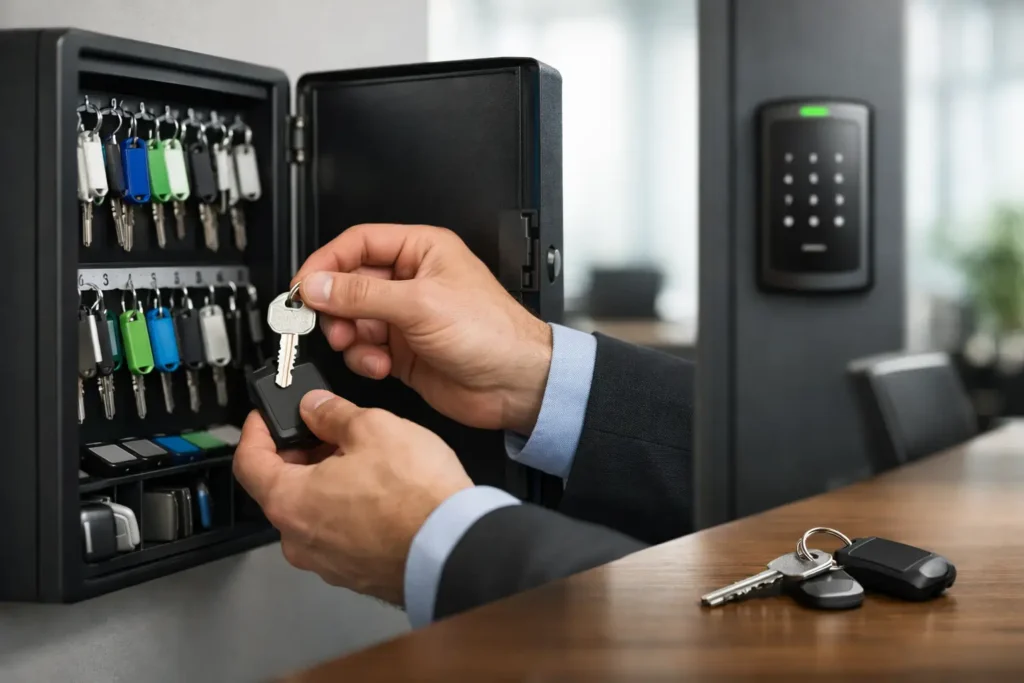
A simple spreadsheet can work for a small office. Larger offices may prefer dedicated key control software or a locked key cabinet with a sign-out record. The tool matters less than keeping the record current.
Give Every Key a Clear Owner
A key should never be assigned to a department in a vague way. Assign it to a named employee, manager, or approved contractor contact. If several people need the same access, issue separate numbered copies where possible instead of passing one key around.
This creates accountability without making staff feel mistrusted. The message is that access is part of workplace security, just like an ID badge, alarm code, or company device.
Set Rules Before You Hand Out Keys
The strongest key system can still fail if keys are issued without approval. Decide who can authorize keys, who can physically issue them, and who can request duplicates. In many offices, a facilities manager or office manager handles daily requests, while senior management approves master keys and restricted-area access.
Keep the rules short and specific. Employees should know that keys are not to be loaned, duplicated, labeled with office details, or left in desks overnight. Contractors should receive only the keys required for the job and return them before leaving whenever practical.
A signed key receipt is useful for any external door, master key, high-security area, or expensive equipment room. The receipt should identify the key code, the date issued, the return date if temporary, and the employee’s responsibility to report loss immediately.
Do not make the process so strict that people avoid reporting problems. Staff should be able to say a key is missing without delay. Fast reporting gives you more options and reduces the chance that a small issue becomes a costly rekeying job.
Handle Lost Keys and Departing Staff Quickly
A lost key needs a response based on what it opens and how it was lost. A cabinet key misplaced inside the office may be lower risk than an exterior master key lost together with an ID card that identifies the business. Context matters.
When a key cannot be found, document the key code, the holder, the last known location, and the doors it opens. Suspend access if an electronic credential is involved, recover any related keys, and assess whether the affected lock should be rekeyed. Rekeying changes the key combination inside the lock, allowing the lock hardware to stay in place while old keys stop working.
Staff departures deserve the same urgency. Include key return in the offboarding checklist, along with badges, access cards, laptops, and parking passes. Check returned keys against the inventory rather than accepting a loose ring of keys at face value. If a key is not returned, decide promptly whether rekeying is justified.
It may feel excessive to rekey after every missing key. It often is not necessary. But delaying a decision on a key that opens the main entrance, private office, or sensitive room leaves the business exposed. A professional locksmith can help assess the lock layout and recommend the most cost-effective response.
Choose the Right Office Key Control System
The right system depends on the office size, number of access points, staff turnover, and the level of security required. A small office with a few trusted employees may only need a numbered key cabinet, a key register, and clear return rules.
For offices with multiple rooms and teams, a restricted keyway system may be a better fit. These keys are harder to duplicate without authorization, which helps management control the number of copies in circulation. This is especially useful for main doors, glass office doors, storage areas, and rooms containing confidential records.
A master key system can simplify daily access. Individual keys can open only assigned doors, while a manager’s master key can open several areas. The trade-off is clear: a master key is convenient, but its loss has a wider impact. Master keys should be limited to a small number of authorized people and stored securely when not in use.
Electronic access control may be worth considering when staff turnover is high or access changes frequently. Cards, fobs, and mobile credentials can often be removed without changing a physical lock. However, electronic systems still need management, maintenance, and a plan for power or system failures. Physical keys usually remain part of the backup plan.
Store Spare Keys Where They Cannot Walk Away
Spare keys should be kept in a locked cabinet, not in an unlocked drawer, reception tray, or common office cupboard. Limit cabinet access to the people who issue keys, and record every removal and return.
Avoid hiding emergency keys outside the office under mats, planters, electrical boxes, or loose fixtures. These locations are familiar to intruders and can turn an avoidable lockout into a security problem. If emergency access is needed, keep a controlled spare with an authorized manager or arrange a clear after-hours locksmith procedure.
For especially sensitive areas, use separate key rings and keep them out of sight. A heavy ring with every office key attached may be convenient, but it creates a major risk if misplaced.
Review Your Records on a Schedule
Key control is not a one-time setup. Review the register at least every six to 12 months, and also after office moves, renovations, management changes, break-ins, or significant staff turnover. Match keys held by employees against your records, remove access that is no longer necessary, and identify locks that have too many copies in circulation.
This review is also a good time to inspect worn locks, loose door closers, damaged glass door hardware, and doors that do not latch correctly. A key system only protects a door that closes and locks properly.
If your office has inherited old keys from previous tenants or years of informal duplication, starting fresh can be safer than trying to untangle the history. Rekeying selected locks and issuing a controlled set of numbered keys gives management a clean starting point.
Get Help When the Lock Layout Is Working Against You
Some offices have mismatched locks, too many independent keys, or a master key setup that no longer reflects how the business operates. In those cases, a locksmith can review the doors, identify practical upgrades, and build a key alike or master key arrangement that reduces key clutter without giving everyone unrestricted access.
Pro-Smith and Lock can assist with office lock replacement, glass door lock work, rekeying, and practical key system planning when access needs to be tightened after a lost key, staff change, or office move. The best solution is usually the one your team can follow every day without confusion.
A well-run office key system is quiet by design. Staff can get where they need to go, managers know who holds access, and a missing key triggers a clear response instead of a scramble.