A metal gate may look solid, but its security often depends on one small component: the lock. To choose locks for metal gates correctly, look beyond the price tag and consider how the gate is built, where it is installed, how often it is used, and who needs access. A lock that works well on a sheltered side gate may fail early on an exposed driveway gate or create daily frustration at a busy property entrance.
The right choice should give you dependable access without making the gate an easy target for forced entry, corrosion, or key problems. For homeowners, tenants, and property managers, the goal is simple: a lock that fits properly, works smoothly, and stays reliable over time.
Start With the Gate Design, Not the Lock
Metal gates come in many forms: swing gates, sliding gates, pedestrian gates, rear access gates, and gates fitted within a fence or wall. Their frame thickness, spacing between bars, latch position, and opening direction affect which lock can be installed securely.
A narrow metal frame may not have enough depth for certain mortise locks. A gate made from open bars may leave a padlock or cylinder too exposed. A sliding gate needs a locking point that holds the gate firmly in position, while a swing gate may need a latch and lock that align correctly every time it closes.
Before buying anything, check whether the gate has an existing lock box, a welded latch bracket, a prepared hole for a cylinder, or no locking hardware at all. Replacing a like-for-like lock is usually simpler and more affordable. Installing a new lock type may require drilling, welding, reinforcement, or adjustment to prevent misalignment.
Choose Locks for Metal Gates Based on Daily Use
The best lock depends partly on what the gate does for your property. A gate that is opened once or twice a week has different needs from one used several times each day by family members, staff, delivery personnel, or tenants.
Padlocks for simple gates and storage areas
A quality padlock can be a practical option for a basic side gate, storage enclosure, utility area, or temporary access point. It is easy to replace and does not always require major modification to the gate.
However, the padlock should not be the only consideration. The hasp, staple, chain, or latch it secures must also be strong. A high-quality padlock attached to a weak metal loop will not provide meaningful protection. For outdoor use, choose a weather-resistant model with a protected or shrouded shackle where possible, as an exposed shackle is more vulnerable to cutting and corrosion.
Gate locks with cylinders for regular entry
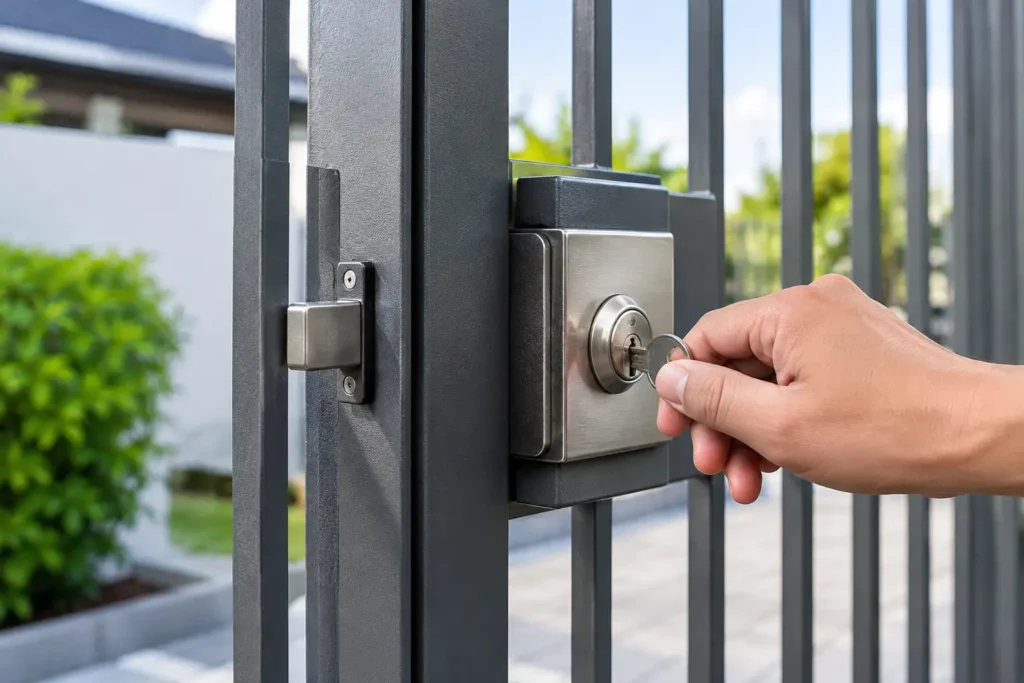
For pedestrian gates used as a normal entrance, a keyed gate lock or narrow-profile lockcase is often more convenient than a padlock. These locks can be operated with a key from the outside and a thumb turn, handle, or key from the inside, depending on the setup.
This option gives a cleaner finish and can be easier for household members or staff to use. It may also be possible to key the gate lock alike with other approved locks on the property, reducing the number of keys you carry. The trade-off is that proper installation matters more. If the lockcase, strike plate, and gate alignment are not set accurately, the lock may become difficult to turn or wear out prematurely.
Deadlocks for higher-security access points
A deadlock is a sensible choice when a metal gate protects a rear entrance, a private walkway, equipment area, or another location where security is the main priority. Unlike a simple spring latch, a deadbolt engages more firmly and is less likely to open if the gate is pushed or rattled.
Deadlocks work best when the receiving frame or wall has a strong strike plate and secure fixing points. A bolt that enters a thin, loose, or poorly attached strike plate can still be forced out of position. The full locking system needs to be assessed, not just the lock body.
Do Not Ignore Weather and Corrosion
Outdoor metal gates deal with rain, heat, dust, moisture, and frequent temperature changes. These conditions can affect both the lock and the gate itself. Rust buildup can make keys difficult to insert, seize moving parts, and cause the gate to sag until the latch no longer meets the strike correctly.
For exterior gates, look for locks designed for outdoor exposure. Stainless steel, brass, marine-grade finishes, and protective coatings generally hold up better than untreated metal components. That does not mean every part is corrosion-proof. Even a good outdoor lock needs occasional care, especially when installed near a driveway, garden, coastal area, or location exposed to direct rain.
Gate alignment is just as important. If you need to lift, pull, or force the gate into place before locking it, the problem may be the hinges, rollers, frame, or latch position. Replacing the lock alone will not fix that issue. A locksmith can identify whether the lock is failing or whether the gate needs adjustment before a new lock is fitted.
Check How Exposed the Lock Will Be
A lock mounted on the outside of a metal gate can be visible and reachable from the street, corridor, or shared access area. In that situation, avoid choices that leave critical components exposed.
For example, a protruding cylinder may be easier to damage if it is not properly protected. A padlock hanging outside the gate may be convenient, but it can also attract attention and be exposed to cutting tools. Where appropriate, a fitted lockcase with protected hardware can offer a neater and less vulnerable arrangement.
The gate design may also create gaps around the latch area. If a hand or tool can reach through the bars to operate an inside thumb turn or release mechanism, the gate needs a different configuration or an added guard plate. Security should be evaluated from both sides of the gate, not only from the side where the key is used.
Think About Keys Before Installation
A lock is only convenient if the right people can use it without compromising security. Before selecting a gate lock, decide who needs access and what happens if a key is lost.
For a family home, a keyed-alike setup can be useful when compatible locks are installed at the gate, main door, mailbox, or other approved access points. For a rental property or office, it may be better to separate keys so that access can be controlled more carefully. A master key system may suit larger premises, but it should be planned properly to avoid giving broad access where it is not needed.
Avoid making too many uncontrolled duplicate keys. If keys have been issued to former tenants, contractors, or staff members, replacing or rekeying the lock may be safer than hoping all copies have been returned. This is especially relevant when the gate is the first barrier to the property.
Installation Quality Determines How Long the Lock Lasts
Even an excellent lock can perform poorly when it is mounted incorrectly. Loose screws, uneven drilling, weak weld points, poor latch alignment, and an improperly fitted strike plate all create problems that customers often mistake for a defective lock.
A professional installation should leave the gate closing smoothly without slamming, lifting, or forcing the key. The lock should sit firmly on the metal frame, the bolt or latch should engage fully, and the cylinder should turn without excessive resistance. For welded gates or custom metalwork, the installer may need to adapt the lock position rather than force a standard lock into an unsuitable space.
If the current lock is jammed, damaged after a break-in attempt, or difficult to operate, avoid forcing it repeatedly. That can bend internal parts, break the key, or damage the gate hardware further. A prompt inspection can prevent a simple replacement from becoming a larger repair.
When It Makes Sense to Call a Locksmith
Some gate lock decisions are straightforward, but others need an on-site assessment. Call a locksmith when the gate is misaligned, the lock has no clear replacement size, the frame needs modification, or you want to improve security without changing the entire gate.
Pro-Smith and Lock can assess the gate, recommend a practical lock type, and install or replace the hardware with attention to fit and daily use. This is particularly helpful when you need the work completed quickly after lost keys, a damaged lock, tenant changes, or a security concern.
A metal gate should feel secure every time you close it, not become another daily problem. Choose a lock that suits the gate you already have, protect it from the conditions around it, and have it fitted properly so it can do its job when you need it most.