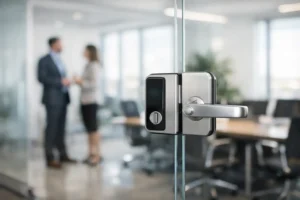
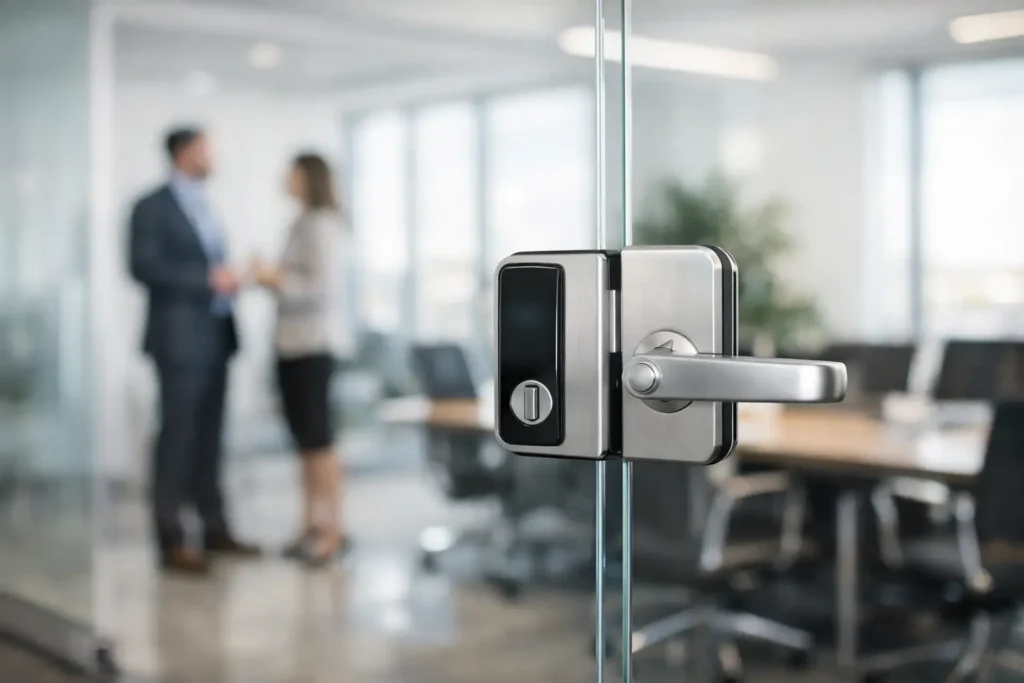
A glass office door can look clean and professional right up until its lock starts sticking, the key goes missing, or staff cannot secure the entrance at closing time. This glass door lock review focuses on the lock options that make practical sense for offices, retail units, meeting rooms, and other glass-door entrances – with attention to security, daily convenience, and safe installation.
Glass doors need more careful lock selection than timber or metal doors. The lock must fit the door’s thickness, the existing glass cutout or patch fitting, the door configuration, and the way people use the entrance. A lock that appears suitable online may not work with your door at all, especially if the glass is tempered and cannot be drilled or altered after installation.
Glass Door Lock Review: Start With the Door Type
The right lock depends first on whether you have a single swing door, a pair of glass doors, a sliding door, or a framed glass partition. A frameless swing door often uses a patch fitting lock mounted near the edge of the glass. Double glass doors commonly use a center lock that secures one door to the other, sometimes with a floor strike or top-and-bottom bolts for added stability.
For an office entrance, a keyed patch lock is often a sensible choice when you need simple, dependable access control without changing the entire door system. It is familiar to staff, quick to operate, and can be rekeyed or replaced when keys are lost. The trade-off is key management. If several employees need access, keys can be copied, misplaced, or left with former staff unless the system is managed carefully.
A sliding glass door needs a different approach. Its lock must hold the panel securely in its closed position without preventing smooth movement. Trying to fit a swing-door lock onto a sliding system is a common and costly mistake. A locksmith should inspect the track, overlap, frame, and existing locking point before recommending a replacement.
The Most Common Glass Door Lock Options
There is no single best lock for every glass door. The best option is the one that provides suitable security without making the entrance difficult or unsafe to use.
Mechanical keyed patch locks
Mechanical patch locks remain a strong choice for private offices, meeting rooms, and smaller commercial spaces. They are straightforward, do not depend on batteries or wiring, and usually cost less than electronic access systems. A quality lock paired with proper installation can provide reliable daily use for years.
They are less suitable when access changes frequently. If tenants rotate, staff turnover is high, or many people require entry, repeated key replacement can become inconvenient. In those cases, a restricted key system or a key-alike arrangement may reduce the number of keys in circulation while keeping access organized.
Double-door center locks
For two frameless glass doors that meet in the middle, center locks are a practical solution. They secure both panels together and can create a neat finish without adding a large external device. However, the lock is only as effective as the door alignment. If either door has dropped, shifted, or begun rubbing against the floor, the bolt may not enter correctly and the lock can feel loose or jammed.
This is why a good glass door lock review should look beyond the lock body. Door closers, hinges, patch fittings, floor springs, and strikes affect how securely the lock performs. Replacing a lock without correcting poor alignment may only postpone the problem.
Digital and smart locks
Digital locks can be useful for interior glass doors where authorized staff need keyless entry. Depending on the model, access can be managed by PIN, card, fingerprint, mobile credential, or a combination of methods. This can make access easier to update when staff join or leave.
The trade-off is that electronic locks need proper setup and a backup plan. Batteries must be changed before they fail, emergency override access must be controlled, and the lock must be compatible with the glass door’s construction. Not every digital lock can be mounted on frameless glass. A model designed for a wooden door may require drilling or a mortise that tempered glass cannot accept.
Electromagnetic locks
Electromagnetic locks are commonly considered for higher-traffic commercial entrances, especially where access cards, intercoms, or door-release buttons are already in use. They can work well with access control systems and allow administrators to add or remove credentials without collecting physical keys.
They also require professional assessment. Maglocks need reliable power, correct mounting brackets, a suitable armature plate, and safe egress planning. For many commercial premises, the door must release appropriately during emergencies. Never add an electromagnetic lock simply to make a glass door harder to open from the inside. Life safety requirements come first.
What Separates a Good Lock From a Cheap Replacement
Price matters, but the cheapest glass lock is rarely the best value. Glass doors are highly visible, frequently used, and less forgiving of poor installation. A low-grade lock can develop a loose cylinder, rough key operation, weak latch engagement, or an unattractive finish that deteriorates quickly.
A worthwhile lock should match the door thickness and cutout, use durable internal components, and have a strike or keeper that engages cleanly. The key should turn without force. When the door is shut, there should be no need to lift, push, or pull the glass panel aggressively to lock it.
Finish also matters in a commercial setting. Stainless steel, satin silver, matte black, and polished finishes should be selected to match existing patch fittings and handles where possible. Mismatched hardware does not necessarily reduce security, but it can make a recently renovated office look poorly maintained.
Installation Matters More Than Most People Expect
A glass lock is not a standard do-it-yourself replacement. Tempered glass is strong in normal use but can shatter if it is drilled, cut, or stressed incorrectly. The existing holes and cutouts have to be measured precisely. If the new lock does not match, forcing it into place is not an acceptable solution.
A professional locksmith will check the glass thickness, lock position, handle clearance, door swing, frame or glass receiving point, and the condition of related hardware. For a double door, both panels must meet properly before the lock can be expected to work smoothly.
This inspection is especially useful when the current lock has failed unexpectedly. What looks like a broken cylinder may actually be a sagging door, worn floor spring, loose patch fitting, or damaged strike. Fixing the root cause can prevent another lock failure a few weeks later.
When Replacement Is Better Than Repair
Repair is often possible when a lock is stiff, a key is difficult to turn, or a cylinder has worn out. Cleaning, adjustment, cylinder replacement, or realignment may restore normal operation without changing all the hardware.
Replacement is usually the better call when the lock body is cracked, parts are unavailable, the door no longer aligns with the existing lock, keys have been lost without a controlled key system, or security needs have changed. An office that once had one or two keyholders may now need a better way to manage staff access. Upgrading early is usually less disruptive than dealing with a lockout during business hours.
If you have moved into a new office, rekeying or replacing the glass door lock should also be considered. You cannot know how many old keys are still in circulation. A new cylinder, new lock, or properly planned master key system gives you a clear starting point.
A Practical Choice for Your Office Entrance
For a small private office, a quality mechanical patch lock with controlled keys may be all that is needed. For a shared office with frequent staff changes, a digital access solution may save time and reduce key-related concerns. For a high-traffic commercial entrance, access control with appropriate emergency-release planning may be the better long-term investment.
The right answer depends on the door and how your premises operate. Pro-Smith and Lock can assess the existing glass door hardware on site, explain the practical options, and carry out lock replacement or repair without guessing from a photo alone.
A glass door should close neatly, lock without force, and give you confidence when the last person leaves. If yours does not, arranging an inspection before it becomes an urgent lockout is a sensible next step.