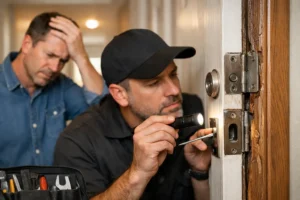
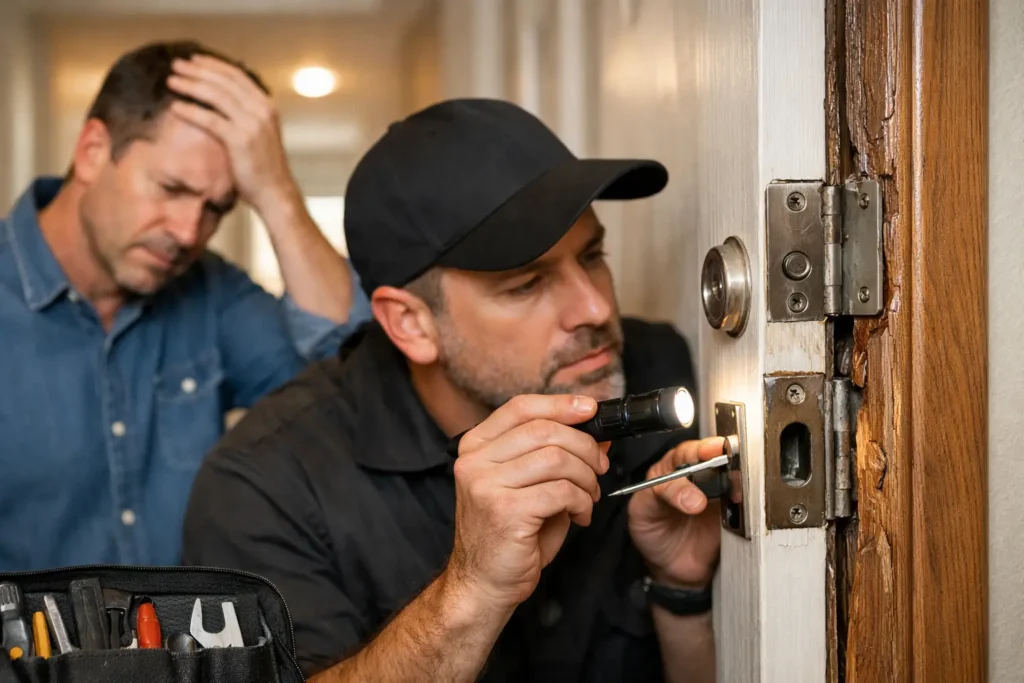
You turn the handle, push like usual, and the door will not move. That moment is frustrating enough when you are trying to leave for work. It is worse when you are locked out of a bedroom, office, gate, or main entrance and asking, why is my door jammed?
A jammed door is not always a lock problem, and it is not always a door problem either. Sometimes the latch is stuck. Sometimes the frame has shifted. Sometimes a key turns but the mechanism inside does not respond. The fastest way to deal with it is to understand what is likely causing the jam, what you can try safely, and when forcing it will only make the repair more expensive.
Why Is My Door Jammed? Start With What You Notice
Before you do anything, pay attention to how the door is behaving. That usually tells you where the issue is.
If the handle turns freely but the door stays shut, the latch or internal lock parts may have failed. If the key will not turn, the cylinder could be worn, misaligned, or blocked. If the door opens a little but catches hard against the frame, the problem may be swelling, shifting, or hinge movement. If nothing moves at all, there may be pressure on the latch, a warped door, or a faulty deadbolt that is not retracting.
This matters because the wrong fix can make a simple service call turn into a lock replacement. Pulling harder, kicking the door, or twisting the key with extra force often breaks the key, bends the latch, or damages the frame.
The Most Common Reasons a Door Gets Jammed
One of the most common causes is misalignment between the latch and the strike plate. Doors move over time. Heat, humidity, daily use, and building settlement can shift the way a door sits in its frame. Even a small change is enough to make the latch catch where it should not.
Hinges are another frequent issue. Loose screws, worn hinges, or a slightly sagging door can change the angle just enough to create friction. In homes and apartments, this often shows up as a bedroom or main door that suddenly starts scraping or sticking near the top or side.
Lock failure is also common, especially in older locks or lower-quality hardware. Inside the lock, small parts wear down. Springs weaken. The latch may stop retracting fully. In some cases, the key still enters and turns, but the mechanism does not release the door.
Weather can play a part too. Wooden doors are especially sensitive to moisture and expansion. After wet weather or in humid conditions, the door may swell and press tightly against the frame. Metal doors and gates can also develop alignment issues if the frame shifts or the hardware loosens.
Then there is user-related wear. A door that has been slammed repeatedly, forced shut against resistance, or used with a damaged key will often develop problems slowly before it jams completely. Many lockouts happen after weeks of warning signs that were easy to ignore.
When the Lock Is the Problem
A jammed door often comes down to the lock itself, especially if the door was working normally and then failed suddenly.
If your key is hard to insert, hard to turn, or gets stuck halfway, the cylinder may be dirty, worn, or internally damaged. If the thumbturn spins without engaging, the connection inside may have come loose. If the handle feels floppy or unusually tight, the internal spring or spindle may be failing.
This is common on bedroom doors, office doors, and older main door locks. The outside may look fine while the internal parts are already at the end of their lifespan. In that situation, lubricant is not always the answer. If the lock is physically worn or broken inside, adding spray may only delay the real fix.
A deadbolt can also jam when there is pressure between the door and frame. Sometimes the bolt is not broken at all. It is just pinned in place because the door has shifted slightly. That is why a locksmith will often test whether the issue is mechanical failure or alignment before recommending replacement.
When the Door or Frame Is the Problem
Not every jammed door needs lock work. Sometimes the hardware is fine, but the door cannot move properly.
A swollen wooden door may feel tight all around the edges. A sagging door may catch at one corner. A metal gate may drag because the hinges have shifted. Glass office doors can develop closing issues when fittings move out of position. In each case, the lock may appear to be the problem because the door will not open, but the real issue is how the door is sitting in the frame.
This is where DIY attempts can go wrong. People often keep turning the key harder, assuming the lock is stiff. But if the latch is under pressure from a misaligned frame, more force will not solve it. It can snap the key or damage the cylinder.
What You Can Safely Try First
If the door is jammed, stay calm and test it gently. Start with the simplest possibilities.
Try pulling or pushing the door lightly while turning the handle or key. If there is frame pressure on the latch or deadbolt, changing the pressure slightly may allow it to release. This works more often than people expect.
Check whether the hinges look loose or whether the door appears uneven in the frame. If the key goes in but will not turn, do not keep forcing it. If you have the correct lock lubricant, a small amount may help if the cylinder is dry, but avoid guessing with random oils or household sprays that attract dirt.
If the latch is visible and the gap allows it, you may be able to confirm whether it is retracting when the handle turns. If it is not retracting at all, the internal mechanism has likely failed.
What you should not do is use excessive force, pry the frame with tools, or keep twisting a key that feels like it may snap. That usually turns a non-destructive opening into a more expensive repair.
Signs You Need a Locksmith
If the door is a main entry door, an HDB unit door, a bedroom with a privacy lock, an office glass door, or any door securing valuables, professional help is usually the safer choice once basic checks fail.
Call a locksmith if the key is stuck, the lock spins without opening, the latch will not retract, the deadbolt is frozen, or the door is clearly misaligned and under pressure. You should also get help quickly if someone is locked inside a room, if access is urgent, or if the lock has been giving problems for days and has now stopped working completely.
An experienced locksmith can usually tell whether the issue needs opening only, lock repair, alignment correction, or full replacement. That matters because not every jammed door needs a new lock, but some do. A worn lock that has already failed once is rarely worth trusting for long-term use.
For customers dealing with urgent lock issues, speed matters as much as skill. A mobile locksmith service like Pro-Smith and Lock is built for exactly that situation – getting to the location, opening the door with minimal damage where possible, and fixing the underlying problem so it does not happen again next week.
How to Reduce the Chance of It Happening Again
Most jammed doors give some warning. The handle starts feeling stiff. The key becomes harder to turn. The door needs an extra push to close. These are not small annoyances to ignore. They are early signs that the lock, hinges, or alignment need attention.
Routine servicing helps, especially on frequently used doors. Replacing worn locks before they fail completely is usually cheaper than dealing with an emergency opening, a broken key, or frame damage after force is used. If a door has shifted, correcting the alignment early can prevent repeated stress on the latch and cylinder.
It also helps to match the lock to the door type and usage. A lightweight interior lock on a heavily used entry door will wear out faster. The same goes for old hardware left in place long after it starts sticking. Good locking hardware should work smoothly, not only when the door is brand new, but every day under normal use.
A jammed door always feels urgent because it interrupts your day immediately. The good news is that the cause is usually identifiable, and in many cases, it can be fixed without major damage when handled properly. If the door is resisting, treat that as a sign to stop forcing it and get the right help before a minor jam turns into a bigger repair.