A glass office door can look clean and modern while still being one of the most vulnerable entry points in a workplace. Choosing the best locks for glass offices is not just about finding a lock that fits. It is about matching the lock to the glass type, door movement, traffic level, and the level of access control your business actually needs.
For office managers, tenants, and business owners in Singapore, the right answer is usually practical rather than complicated. A lock should secure the door reliably, allow authorized staff to enter without hassle, and be serviceable when keys are lost, staff change, or the lock begins sticking.
What Makes a Glass Office Lock Different?
Glass doors need locks designed for glass. Unlike a timber or metal door, a frameless glass panel cannot simply be drilled or altered after installation. Most office glass is tempered, and drilling tempered glass after it has been installed can cause the entire panel to shatter.
That is why the lock body, strike plate, and door fittings must be selected before any work starts. A professional locksmith will check whether your door is frameless, framed, sliding, double-leaf, or fitted with a floor spring. They will also inspect the glass thickness and the existing patch fittings.
The best option also depends on how your office operates. A private director’s room may only need a key lock. A busy shared office, meeting room area, or restricted records room may benefit more from card access or a keypad system.
Best Locks for Glass Offices: The Main Options
Glass Patch Locks for Frameless Swing Doors
Patch locks are among the most common choices for frameless glass office doors. They are installed with purpose-made glass patch fittings that clamp securely around the glass, without the need for drilling into a completed tempered panel.
Many patch locks use a keyed cylinder on one side and a thumbturn on the other. This gives staff a simple way to lock up after office hours while allowing a quick exit from inside. They are a dependable choice for private offices, small businesses, consultation rooms, and meeting rooms.
The main advantage is simplicity. Replacement keys are straightforward, and a locksmith can often replace a worn cylinder or damaged lock case without changing the full door system. The trade-off is that physical keys can be copied, misplaced, or retained by former employees. If staff turnover is frequent, consider a restricted key system or a lock that can be rekeyed.
Central Locks for Double Glass Doors
Double glass doors need a lock that secures both panels properly. A center lock, often installed where the two glass leaves meet, is a practical option for office entrances and larger meeting rooms.
Depending on the door setup, the inactive leaf may be held by top and bottom bolts while the active leaf is secured with the main lock. This arrangement helps prevent the doors from being pushed apart at the center. It also keeps the entrance neat without adding a bulky lock to the glass.
Correct alignment matters here. If the floor spring is weak, the doors sag, or the panels do not close evenly, even a quality lock can become difficult to operate. Fixing the alignment first is usually more affordable than repeatedly forcing a lock that does not line up with its strike.
Magnetic Locks for Controlled Access
A magnetic lock, also called a maglock, is often chosen for offices that need controlled entry throughout the day. It uses an electromagnet mounted to the frame or header and an armature plate fitted to the door. When powered, the magnet holds the door closed. Entry can be controlled using a card reader, keypad, intercom, fingerprint reader, or mobile credential.
This is a suitable option for staff-only areas, server rooms, clinics, training centers, and offices with multiple employees. It removes the daily problem of distributing and collecting physical keys, and access can be changed when a staff member leaves.
However, a maglock is not a standalone security decision. It needs a proper power supply, wiring, exit device, and emergency-release arrangement. Fire safety and building requirements must be considered, particularly in shared commercial buildings. A poorly planned magnetic lock may create inconvenience during a power failure or make emergency exit arrangements unsafe.
Electric Strikes and Electric Drop Bolts
For some glass door configurations, an electric strike or electric drop bolt can provide a cleaner controlled-access setup than a magnetic lock. Electric drop bolts are commonly used with glass doors where the bolt locks into a receiver in the floor, frame, or adjacent glass fitting.
These systems can work well with access cards and keypads while keeping the door appearance minimal. They can also offer a more positive locking action than a magnet, depending on the door design.
The limitation is compatibility. The door must have the right fittings, clearances, and wiring path. Installation may involve coordinating with the building management, glass contractor, or electrician. It is not a case of choosing a lock solely from a photo and expecting it to fit every glass door.
Digital Keypad and Smart Access Locks
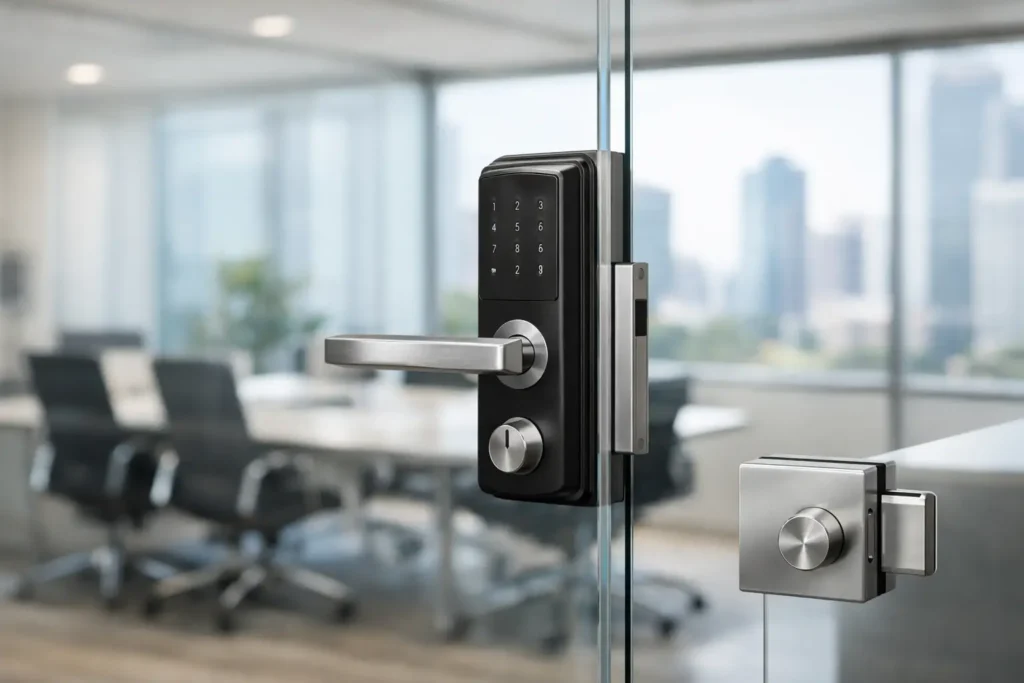
For small offices that want keyless entry without a full card-access system, a digital keypad lock can be a practical middle ground. Authorized users enter a PIN, and the office can change the code when needed. Some systems also support cards, fingerprints, or mobile access.
This works best when the lock is specifically made for a glass door and is installed on a compatible glass thickness. It is useful for offices with cleaners, contractors, flexible work schedules, or shared meeting spaces where issuing keys would be inconvenient.
The trade-off is maintenance. Batteries need checking, users need clear instructions, and the office should keep a backup entry method. Cheaper digital locks can be frustrating when the keypad becomes unreliable or the latch does not suit the door’s closing action. Choose a system with available replacement parts and local locksmith support.
How to Choose the Right Lock for Your Office
Start with the door itself. Is it a frameless swing door, sliding glass door, single door, or double door? Does it have an aluminum frame, a floor spring, or existing patch fittings? These details determine which lock can be installed safely.
Next, think about access. A low-traffic private room may only need a good patch lock with quality keys. An office entrance used by multiple staff members may need card access, a keypad, or a master key arrangement. If several rooms need separate access levels, a properly planned master key system can reduce the number of keys employees carry while keeping sensitive rooms restricted.
Also consider what happens when something goes wrong. Lost keys, damaged cylinders, access cards that stop working, and doors that will not latch are common office issues. Select a lock that can be repaired or rekeyed locally rather than one that requires a full replacement for a small fault.
Common Problems That Should Not Be Ignored
A glass door lock that sticks is not always a lock problem. The floor spring may be failing, the glass door may be misaligned, or the patch fitting may have loosened over time. Forcing the key or slamming the door can damage the cylinder, scratch the glass fittings, and leave the office unsecured.
Another common problem is a key that turns but does not lock. This may point to a worn cam, a loose lock body, or a strike that is no longer aligned. If the door has been difficult to close for weeks, address it before the lock fails completely and leaves staff locked out or unable to secure the office after hours.
For businesses changing tenants or employees, rekeying is often a sensible first step. It is usually faster and more cost-effective than replacing every lock, provided the current hardware is still in good condition. If the lock is old, damaged, or no longer suitable for the office’s access needs, replacement may offer better value.
Professional Installation Matters for Glass Doors
Glass office door lock work requires careful handling. A locksmith should confirm the glass thickness, measure the existing fittings, check door alignment, and recommend a lock that works with the door rather than forcing an unsuitable product onto it.
Pro-Smith and Lock provides on-site glass office door lock replacement, repair, opening, and access solutions across Singapore. For urgent problems, a mobile locksmith can assess the issue at your location and help restore access or security without unnecessary delays.
If your office door is hard to lock, keys have gone missing, or you are planning a security upgrade, do not wait for the lock to fail at closing time. A lock matched to your glass door and daily office routine gives your team one less problem to worry about.