A glass office door can make a workspace look open, modern, and professional. It can also become the weakest point in your security if the lock, frame, or access setup is not right. If you are wondering how to secure office glass door access without turning the office into a fortress, the answer is usually a mix of the right hardware, better entry control, and a few practical habits.
Most office break-ins do not happen because the door is made of glass alone. They happen because the door has a weak lock, poor alignment, easy key access, or no real control over who comes in after hours. That is good news for office managers and business owners because it means security can often be improved without replacing the whole entrance.
How to Secure Office Glass Door Access Without Guesswork
The first step is to identify what type of glass door you have. Some office doors are frameless with patch fittings, while others are aluminum-framed glass doors with a standard lock body. Some swing open, others slide, and each setup needs a different security approach. A lock that works well on a framed glass door may not be suitable for a frameless panel.
That matters because many businesses try quick fixes that do not really solve the problem. Adding a cheap secondary latch or a stick-on device may feel like action, but if the main lock is worn out or the glass door is misaligned, the real risk stays the same. A proper assessment saves time and avoids spending money twice.
In most offices, security should focus on three things at the same time: stopping forced entry, controlling authorized access, and reducing lock failure. If one of these is missing, the door may still be easy to exploit.
Start With the Lock, Not the Glass
When people think about glass doors, they usually worry about the panel itself. In practice, the lock is often the first problem. A basic latch lock may be enough for internal meeting rooms, but it is often not enough for a main office entrance, especially in shared buildings or ground-floor units.
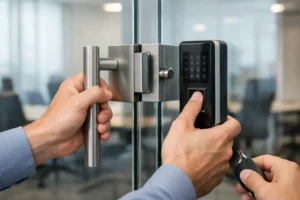
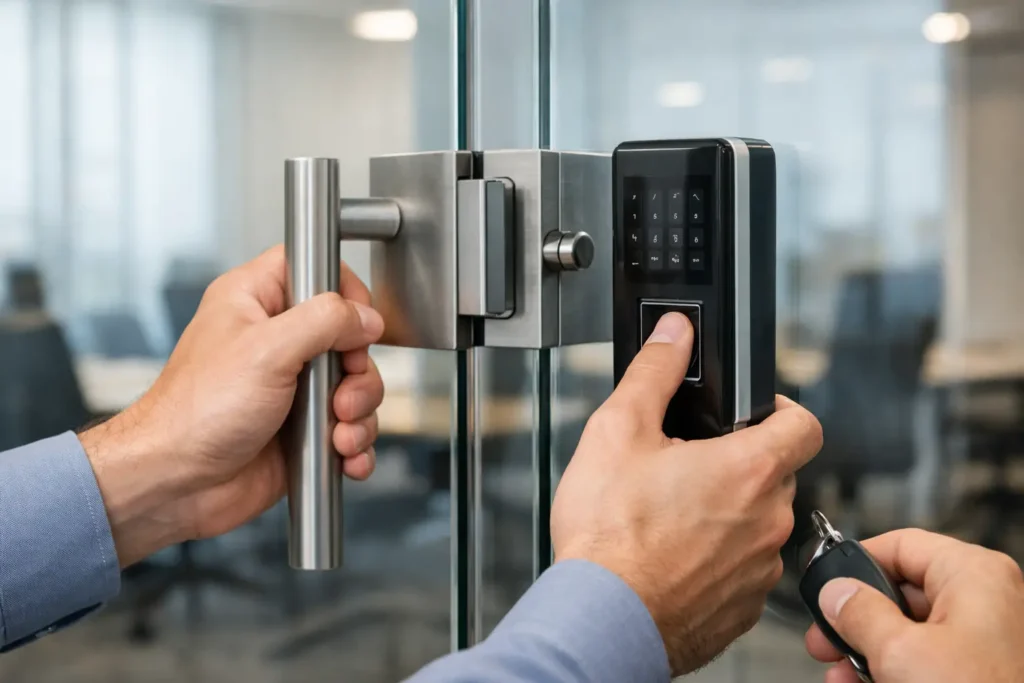
A deadbolt-style solution, a proper glass door lock with a secure strike, or an access control lock can make a major difference. For some offices, a keyed lock is still appropriate. For others, keypad, card, or digital access is a better fit because staff turnover makes key control difficult.
The trade-off is simple. Traditional keyed systems cost less upfront, but they create risk when keys are copied, lost, or not returned. Digital access systems give more control and faster revocation, but they cost more and need proper setup. If your office has frequent staffing changes, cleaners, vendors, or after-hours access, digital entry often becomes the more practical choice.
Check the Door Alignment and Closing Force
Even a good lock cannot secure a door that does not close properly. Glass office doors often develop alignment issues over time. The door may drag slightly, fail to latch fully, or leave pressure on the lock body. Staff may not notice it until the key starts sticking or the lock jams.
That is more than an inconvenience. A poorly aligned glass door can often be pushed, pulled, or manipulated more easily than a properly fitted one. In some cases, the lock is blamed when the real issue is the floor spring, hinge, pivot, or strike alignment.
A simple inspection should confirm that the door closes smoothly, latches fully every time, and does not bounce back after closing. If it does, fixing the alignment should come before any lock upgrade.
Add Access Control Where It Makes Sense
If multiple people use the office throughout the day, access control is usually the cleanest answer. This does not always mean a complex system. For many small and mid-sized offices, a basic keypad or card access setup is enough to improve security and reduce key-related problems.
This is especially useful when employees arrive at different times or when managers do not want physical keys floating around. If someone leaves the company, access can be removed without changing the whole lock. That saves money over time and gives better control over who can enter.
There is still an it-depends factor. If your office has low traffic and only one or two trusted keyholders, a high-quality keyed lock may be perfectly fine. If the office has shared use, regular visitors, or sensitive files and equipment inside, access control usually pays off faster.
Use the Right Lock for Frameless Glass Doors
Frameless glass doors need specialized hardware. That is where many security problems begin because owners try to adapt standard locks to a door they were never designed for. A proper frameless glass door lock should match the glass thickness, door swing, and mounting points.
For double glass doors, the setup may also need a floor lock, double-door lock, or a secure meeting stile arrangement. For single doors, patch locks and compatible strikes are more common. The right setup depends on whether the door is a main entrance, a private office, or an internal partition.
This is one of the cases where professional fitting matters. Glass doors are less forgiving than timber or metal doors. Poor installation can damage the door, weaken the hardware, or create constant lock issues that frustrate staff.
Do Not Ignore the Surrounding Security
If you want to know how to secure office glass door entrances properly, look beyond the lock itself. The nearby environment affects security more than many businesses realize.
Good lighting outside the entrance discourages casual intrusion. Reception visibility helps if the office receives visitors. A working door closer prevents the door from being left ajar. Even simple privacy frosting can reduce the temptation of visible laptops, devices, and stock placed near the glass.
For after-hours protection, alarm contacts on the glass door or nearby surveillance can add another layer. These do not replace a good lock, but they strengthen the overall setup. Security works best in layers. If one measure fails, another should still slow entry down or create a record of it.
Key Management Is Often the Real Weak Spot
Many office security issues are not caused by forced entry. They come from uncontrolled keys. Former staff still have access. Spare keys were handed to too many people. No one knows how many copies exist. That is a common problem in small businesses, especially after years of turnover.
If that sounds familiar, replacing or rekeying the office glass door lock is often smarter than continuing with uncertainty. A master key system may also help if the business manages multiple rooms or units and wants simpler control without carrying a large set of keys.
For businesses with frequent personnel changes, this is where a locksmith can give practical advice instead of a one-size-fits-all answer. The most secure setup is not always the most expensive one. It is the one your team can manage properly every day.
When to Upgrade Instead of Repair
A lock that sticks, feels loose, or needs repeated adjustments is already telling you something. Repairs can help when the issue is minor, but there is a point where replacement is the more cost-effective move.
Upgrade the lock if the key turns inconsistently, the latch does not catch properly, the lock body is visibly worn, or the current system no longer suits your access needs. If your office recently had staff changes, a lost key incident, or a break-in attempt, that is also a strong reason to review the whole door setup.
In many cases, businesses wait too long because the lock still technically works. But office security should not be judged by whether the door closes today. It should be judged by whether the system still protects the office reliably next month.
Professional Help Saves Time on Glass Door Security
Glass doors are common in offices, but they are not a basic DIY lock job. The hardware has to match the door type, the alignment has to be right, and the locking method has to fit how your team actually uses the space. A poor fit can create constant trouble, from lockouts to doors that fail to secure after closing.
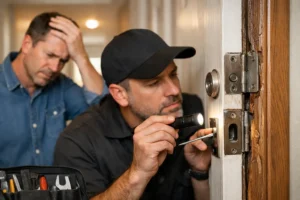
That is why many business owners call a locksmith before a small issue becomes an urgent one. An experienced provider can inspect the current lock, check the door condition, recommend upgrades that fit the budget, and handle replacement without unnecessary downtime. For offices that need quick, practical help, that kind of support matters.
If your entrance feels vulnerable, sticks when locking, or still relies on outdated key control, now is the right time to fix it. A secure office glass door should not slow business down. It should let your team work with confidence and let you leave at the end of the day without second-guessing the lock.